Filters
Products Found: 395

Water Pressure Sensor Analog Output DFRobot Gravity Sensor
The **Water Pressure Sensor Analog Output DFRobot Gravity Sensor** is a compact and reliable pressure measurement module designed to detect and monitor water pressure in various liquid systems. It works by converting hydraulic pressure into an analog voltage signal, which can be easily read by microcontrollers such as Arduino, ESP32, and other compatible development boards. This allows real-time monitoring of water depth, flow pressure, or liquid levels in closed or open systems. This sensor is widely used in applications such as water level monitoring, smart irrigation systems, tank pressure measurement, and environmental sensing projects. As part of the DFRobot Gravity series, it features a user-friendly interface, stable signal output, and easy plug-and-play compatibility with Gravity connectors. With its accurate performance, durable construction, and simple integration, the Water Pressure Sensor is an excellent choice for students, hobbyists, and engineers working on fluid monitoring and smart automation systems.

Rain Sensor Module
The **Rain Sensor Module** is a simple and reliable electronic device designed to detect rainfall or the presence of water droplets. It works by using a sensing board with conductive tracks that measure changes in resistance when water comes into contact with the surface, generating an output signal that can be read by microcontrollers such as Arduino, ESP32, and other embedded systems. This allows it to identify rain or moisture conditions in real time. This module is commonly used in automatic weather stations, smart irrigation systems, rain-activated window control systems, and home automation projects. It typically provides both analog and digital outputs, making it easy to integrate into a wide range of DIY and IoT applications. With its simple design, low cost, and dependable performance, the Rain Sensor Module is a practical choice for students, hobbyists, and engineers working on weather detection and smart environmental control systems.

Water Sensor
The **Water Sensor** is a simple and effective electronic module designed to detect the presence, level, or leakage of water in various applications. It works by using exposed conductive traces that measure changes in resistance when water comes into contact with the sensing surface, producing an analog or digital signal that can be read by microcontrollers such as Arduino, ESP32, and other development boards. This sensor is commonly used in applications such as rain detection systems, water leakage alarms, automatic irrigation systems, and liquid level monitoring projects. Its compact design and easy integration make it suitable for both beginners and advanced users working on DIY electronics and IoT-based systems. With its low cost, reliable performance, and simple operation, the Water Sensor is a practical choice for students, hobbyists, and engineers developing water detection and smart automation solutions.

Gravity Analog TDS Sensor Meter for Arduino
The **Gravity Analog TDS Sensor Meter for Arduino** is a water quality monitoring module designed to measure Total Dissolved Solids (TDS) in liquids, helping determine water purity and mineral content. It works by detecting the electrical conductivity of water and converting it into an analog signal that can be read by microcontrollers such as Arduino, ESP32, and other compatible platforms. Higher conductivity indicates a higher concentration of dissolved ions, which corresponds to higher TDS levels. This sensor is widely used in applications such as drinking water testing, hydroponics, aquaculture, aquariums, and environmental monitoring systems. It is designed for easy integration with Gravity-series interfaces, offering stable readings and simple calibration. With its reliable performance, compact design, and straightforward operation, the Gravity Analog TDS Sensor Meter is an essential tool for students, hobbyists, and engineers working on water quality analysis and smart environmental projects.

Water Turbidity Sensor For Arduino
The **Water Turbidity Sensor for Arduino** is a compact and efficient device designed to measure the clarity or cloudiness of water by detecting the amount of suspended particles present in a liquid. It operates using an optical sensing method, where light is passed through the water and a receiver detects how much is scattered, producing an analog signal proportional to the turbidity level. This makes it suitable for monitoring water quality in real time. This sensor is widely used in environmental monitoring systems, aquaculture, hydroponics, and water treatment applications to ensure safe and clean water conditions. It is compatible with Arduino and other microcontroller platforms, allowing easy integration into IoT-based and automated monitoring systems. With its simple interface, reliable performance, and practical design, the Water Turbidity Sensor is an excellent choice for students, hobbyists, and engineers working on water quality measurement and smart environmental projects.

Gravity Analog Turbidity Sensor For Arduino
The **Gravity Analog Turbidity Sensor for Arduino** is a water quality monitoring module designed to measure the clarity or cloudiness of liquids. It works by using an optical sensing method, where an infrared light passes through the water and a photodetector measures how much light is scattered by suspended particles. The more particles present, the higher the turbidity level, allowing the sensor to provide an analog voltage output that represents water clarity. This sensor is widely used in environmental monitoring, water treatment systems, aquaculture, and hydroponics projects to assess water purity in real time. It is compatible with Arduino and other microcontroller platforms, making it easy to integrate into IoT and automation systems. With its stable performance, simple interface, and reliable measurement capability, the Gravity Analog Turbidity Sensor is a valuable tool for students, hobbyists, and engineers working on water quality analysis and smart environmental solutions.

Water Flow Sensor G1/2 Inch
The **Water Flow Sensor G1/2 Inch** is a compact and reliable device designed to measure the flow rate of water in pipes and liquid systems. It works using a small internal turbine that rotates as water passes through, generating electrical pulses proportional to the flow rate. These pulses can be easily read by microcontrollers such as Arduino, ESP32, and other embedded systems to calculate real-time water usage and flow speed. This sensor is commonly used in applications such as smart irrigation systems, water dispensers, beverage machines, industrial flow monitoring, and home automation projects. With its G1/2 inch threaded design, it is easy to install in standard plumbing setups, ensuring a secure and leak-free connection. Durable and efficient, the Water Flow Sensor G1/2 Inch is a practical choice for students, hobbyists, and engineers working on water management and fluid control systems.

INA219 Current Sensor Module
The **INA219 Current Sensor Module** is a high-precision power monitoring device designed to measure both current and voltage in DC circuits. Based on the INA219 chip, it uses a shunt resistor and built-in ADC to accurately detect current flow while also measuring bus voltage, allowing it to calculate power consumption in real time. The module communicates via the I2C interface, making it easy to integrate with microcontrollers such as Arduino, ESP32, Raspberry Pi, and other embedded systems. This sensor is widely used in applications such as battery monitoring, solar power systems, IoT energy tracking, and robotics, where accurate power usage data is important. It offers high resolution and excellent accuracy even at low current levels, making it more precise than many analog current sensors. With its compact design, easy wiring, and reliable performance, the INA219 Current Sensor Module is a popular choice among students, hobbyists, and engineers working on smart energy and monitoring projects.

MAX471 Voltage Current Sensor Module
The **MAX471 Voltage Current Sensor Module** is a compact power monitoring device designed to measure DC current and voltage in electronic circuits with good accuracy and stability. Based on the MAX471 integrated circuit, it provides a proportional analog output that represents the current flowing through the load, making it easy to interface with microcontrollers such as Arduino, ESP32, and other embedded systems. It is commonly used for battery monitoring, power supply testing, and energy consumption measurement in DIY electronics and robotics projects. This module features built-in current sensing with low power loss, allowing efficient measurement without significantly affecting the circuit being tested. Its simple two-output design typically provides both current and voltage signals, enabling real-time monitoring of electrical parameters. With its compact size, easy integration, and reliable performance, the MAX471 sensor module is widely used by students, hobbyists, and engineers working on power management, IoT systems, and electronic testing applications.

Current Sensor ACS712 30A
The **Current Sensor ACS712 30A** is a Hall-effect-based current measurement module designed to accurately detect both AC and DC currents up to ±30A. It provides electrical isolation between the sensing circuit and the measured current path, ensuring safe operation in high-power electronic systems. The sensor converts current flow into a proportional analog voltage output, making it easy to interface with microcontrollers such as Arduino, ESP32, and other embedded platforms for real-time monitoring and control. This module is widely used in applications such as motor control, power supply monitoring, battery management systems, and energy usage measurement. Its low-resistance internal conductor helps minimize power loss while maintaining reliable and stable readings. With its compact size, simple integration, and dependable performance, the ACS712 30A current sensor is a popular choice for students, hobbyists, and engineers working on power electronics and IoT-based monitoring systems.

Current Sensor ACS712 20A
The **Current Sensor ACS712 20A** is a Hall-effect-based module designed to measure both AC and DC current with electrical isolation for safe and reliable operation. It is capable of sensing current up to ±20A and converts it into a proportional analog voltage output that can be easily read by microcontrollers such as Arduino, ESP32, and other embedded systems. The sensor provides accurate real-time current monitoring while minimizing power loss due to its low-resistance internal conductor path. Widely used in electronics, robotics, and energy monitoring applications, the ACS712 is ideal for projects involving motor control, power supply testing, battery monitoring, and load detection. Its compact design and simple interface make it easy to integrate into various systems, while its built-in isolation improves safety when working with higher currents. The ACS712 20A sensor is a popular choice among students, hobbyists, and engineers for reliable and cost-effective current measurement solutions.

ACS709 Current Sensor Carrier -75A to +75A
The ACS709 Current Sensor Carrier (-75A to +75A) is a high-precision Hall-effect current sensing module designed to measure both AC and DC currents in a wide range of electronic and power systems. Based on the ACS709 sensor IC, it provides electrically isolated current measurements, ensuring safe and reliable monitoring without direct electrical contact with the high-power circuit. With a measurement range of -75A to +75A, it is suitable for applications involving motor control, power supply monitoring, battery management systems, and industrial automation. The module outputs an analog voltage proportional to the sensed current, making it easy to interface with microcontrollers such as Arduino, ESP32, and other embedded platforms. Its low-resistance current path helps minimize power loss while maintaining accurate readings, and its built-in isolation enhances safety in high-current environments. Compact and easy to integrate, the ACS709 Current Sensor Carrier is widely used by engineers, students, and developers working on energy monitoring, robotics, and power electronics projects where reliable current measurement is essential.

MyoWare 2.0 Link Shield, DEV-18425
The MyoWare 2.0 Link Shield is an expansion board designed to simplify the connection between a MyoWare 2.0 Muscle Sensor and an Arduino or compatible microcontroller. It provides a convenient 3.5 mm TRS jack for linking boards using a cable, along with snap connectors that allow the shield to be stacked directly onto the MyoWare 2.0 sensor without soldering, making setup fast and user-friendly. This shield includes onboard switches for power control and output selection, allowing users to choose between RAW, rectified (RECT), or envelope (ENV) EMG signals depending on the application. It also features status LEDs for power and signal indication, as well as a reference/ground jumper to support stable signal measurement. The design is focused on improving flexibility and modularity in EMG projects, especially in wearable and robotics applications. Overall, the MyoWare 2.0 Link Shield is widely used in human–machine interface systems, biomedical experiments, and robotics projects where muscle signals need to be transmitted cleanly and efficiently to a microcontroller for processing.

MyoWare 2.0 LED Shield, DEV-21869
The MyoWare 2.0 LED Shield is an add-on module designed to visualize muscle activity in real time when used with the MyoWare 2.0 Muscle Sensor system. It features a 10-segment LED bar graph that lights up based on the strength of the detected EMG signal, allowing users to instantly see how much a muscle is being activated. The harder the muscle flexes, the more LEDs illuminate, providing an intuitive and engaging visual feedback system. This shield also includes a built-in 40 mAh LiPo battery and USB-C charging circuit, enabling it to power the MyoWare 2.0 sensor wirelessly for cleaner signal readings and improved portability. It connects easily using snap-style connectors, requiring no soldering, and is designed for quick stacking directly onto the muscle sensor. Additional indicators show charging status and power conditions, making it user-friendly for development and testing. Overall, the MyoWare 2.0 LED Shield is widely used in educational demonstrations, fitness feedback systems, robotics control experiments, and human–machine interface projects where visualizing muscle activity is essential.

MyoWare 2.0 Power Shield, DEV-21868
The MyoWare 2.0 Power Shield is a compact power management module designed to supply stable, portable power to the MyoWare 2.0 Muscle Sensor system. It includes a built-in 40 mAh LiPo battery and a USB Type-C charging circuit, allowing the sensor to be used without external power sources. This makes it ideal for wearable and mobile electromyography (EMG) applications where clean, isolated power is important for accurate muscle signal readings. The shield features snap connectors that allow it to stack directly onto the MyoWare 2.0 Muscle Sensor without soldering, making setup quick and beginner-friendly. It also includes status indicators for charging, full battery, and system power, along with a simple onboard switch for easy control. By providing regulated low-noise power, the module helps improve signal quality while reducing electrical interference and safety risks. Overall, the MyoWare 2.0 Power Shield is widely used in biomedical projects, robotics, and human–machine interface systems, especially where muscle sensors need to operate in a fully portable and self-contained setup.

MyoWare 2.0 Muscle Sensor Version 2.0.4, DEV-21265
The MyoWare 2.0 Muscle Sensor Version 2.0.4, DEV-21265 is a wearable electromyography (EMG) sensor module designed to detect and measure electrical activity produced by skeletal muscles. It uses surface electrodes placed on the skin to capture muscle signals, which are then processed into clean analog outputs that can be read by microcontrollers such as Arduino, ESP32, and other development boards. This version (2.0.4) features improved stability, snap-style electrode connections for easier setup, and multiple output modes including raw, rectified, and envelope signals for flexible signal processing. The sensor is widely used in robotics, prosthetics, human–machine interfaces, and biomedical learning projects, allowing users to control systems through muscle movement. With its adjustable gain, compact wearable design, and reliable signal conditioning, the MyoWare 2.0 Muscle Sensor is a powerful tool for students, researchers, and developers working on muscle-controlled systems and biofeedback applications.

Fingerprint Sensor R307S
The **Fingerprint Sensor R307S** is an optical biometric module designed for accurate fingerprint recognition and secure identity verification in embedded systems. It features an integrated fingerprint acquisition system with built-in DSP processing and FLASH memory, allowing it to perform fingerprint enrollment, storage, matching, and search functions directly on the module. The sensor communicates via a TTL UART serial interface, making it easy to connect with microcontrollers such as Arduino, ESP32, and other 3.3V/5V compatible systems. It supports both 1:1 verification and 1:N identification modes, making it suitable for access control, attendance systems, and security-based applications. With fast response time, stable performance, and compact design, the R307S is widely used in DIY electronics, educational projects, and professional biometric systems where reliable fingerprint authentication is required.

Heart Beat Heart Rate Sensor Module MAX3010X
The **Heart Beat / Heart Rate Sensor Module MAX3010X** is a compact and high-precision optical biosensor designed to measure heart rate and blood oxygen saturation (SpO2). Based on the MAX3010X series chipset, it uses integrated LEDs and a photodetector to detect variations in blood flow through a non-invasive method, typically from a fingertip or earlobe. This module is widely used in wearable health devices, fitness monitoring systems, and biomedical research projects due to its accuracy, low power consumption, and small form factor. It communicates easily with microcontrollers such as Arduino, ESP32, and Raspberry Pi via I2C interface, making integration simple for developers and hobbyists. With its reliable performance and dual-function capability for heart rate and SpO2 monitoring, the MAX3010X sensor module is ideal for students, engineers, and researchers working on modern health tracking and IoT-based medical applications.

Gravity Analog pH Sensor Meter Kit V2
The **Gravity Analog pH Sensor Meter Kit V2** is an upgraded and high-precision pH measurement system designed for accurate detection of acidity and alkalinity in liquid solutions. Developed for use in environmental monitoring, aquaponics, aquaculture, hydroponics, and laboratory experiments, it provides stable and reliable pH readings through an improved signal conditioning board and high-quality probe. The module supports a wide operating voltage range and is compatible with both 3.3V and 5V microcontroller platforms, making it easy to integrate with Arduino, ESP, and similar systems. Featuring enhanced signal filtering, low noise output, and a user-friendly two-point calibration system using standard buffer solutions, the kit ensures improved measurement accuracy and ease of use. With its durable design and consistent performance, the Gravity Analog pH Sensor Meter Kit V2 is a trusted choice for students, hobbyists, and engineers working on water quality analysis and smart environmental systems.

Heart Rate Monitor AD8232
The **Heart Rate Monitor AD8232** is a compact and efficient ECG (electrocardiogram) signal conditioning module designed to measure the electrical activity of the heart. Based on the AD8232 integrated front-end chip, it extracts, amplifies, and filters weak bioelectric signals to provide a clean analog output suitable for microcontrollers such as Arduino and other development platforms. This module is commonly used in health monitoring systems, biomedical experiments, and educational projects to study heart rate and ECG waveforms. It supports single-lead ECG measurement using electrode pads and includes features like noise reduction and leads-off detection for improved signal stability. Easy to interface and highly reliable, the AD8232 heart rate monitor is widely used by students, researchers, and developers working on wearable health devices and bio-signal processing applications.

Pulse Sensor China
The **Pulse Sensor (China)** is a compact and affordable heart rate monitoring module designed to detect pulse signals through a simple optical sensing method. It works by measuring changes in blood flow using a light-based sensor placed on the fingertip or earlobe, converting these variations into analog signals that can be processed by microcontrollers such as Arduino and other development boards. This sensor is widely used in health monitoring projects, fitness devices, and educational experiments due to its ease of use and quick integration. Its lightweight design and low power consumption make it suitable for portable and wearable applications. Ideal for students, hobbyists, and beginners, the Pulse Sensor (China) provides a simple and accessible way to explore basic physiological monitoring and embedded health-related projects.

Biomedical Sensor Pad 10 pack
The **Biomedical Sensor Pad (10 Pack)** is a set of high-quality adhesive electrode pads designed for reliable bio-signal measurement in health monitoring, research, and electronic projects. These pads are used to capture electrical signals from the human body, making them suitable for applications such as ECG, EMG, EEG experiments, and other biomedical sensing systems. Each pad features a comfortable adhesive surface that ensures stable skin contact while maintaining good signal quality during use. The snap connector design allows quick and secure attachment to compatible sensor cables and modules, enabling easy integration with microcontroller-based systems. Widely used in educational, prototyping, and research environments, this 10-pack offers a convenient and cost-effective solution for students, developers, and engineers working on biomedical and human–machine interface projects.

PH Sensor with Module
The **pH Sensor with Module** is a reliable and easy-to-use electronic system designed to measure the acidity or alkalinity of liquids in various applications. It typically consists of a pH probe and a signal conditioning module that converts weak analog signals into a stable output readable by microcontrollers such as Arduino and other development boards. This sensor is widely used in water quality monitoring, hydroponics, aquariums, environmental testing, and laboratory experiments. The probe is sensitive and capable of detecting small changes in hydrogen ion concentration, providing accurate pH readings when properly calibrated. With its simple interface, stable performance, and broad compatibility, the pH Sensor with Module is an essential tool for students, hobbyists, and engineers working on liquid analysis and smart environmental systems.

Electrodes for MyoWare Muscle Sensors 6 Pack
The **Electrodes for MyoWare Muscle Sensors (6 Pack)** are disposable, pre-gelled EMG electrode pads designed for use with the MyoWare muscle sensor system in bio-signal and robotics applications. These electrodes provide reliable skin contact to accurately capture electrical activity generated by muscles, making them ideal for projects involving electromyography (EMG), prosthetics, and human–machine interaction systems. Each electrode features a snap connector for quick and secure attachment to compatible sensor cables, ensuring stable signal transmission during use. The adhesive backing is designed to maintain good contact with the skin while remaining easy to remove after use, making them suitable for short-term experimental sessions. Commonly used in educational, research, and prototyping environments, this 6-pack of electrodes is a practical accessory for students, developers, and engineers working with MyoWare-based muscle sensing projects.

Single Lead Heart Rate Monitor AD8232 Original
The **Single Lead Heart Rate Monitor AD8232 (Original)** is a biomedical signal acquisition module designed to measure and condition the electrical activity of the heart for ECG (electrocardiogram) applications. Built around the AD8232 integrated front-end chip, it extracts, amplifies, and filters weak bioelectric signals from the body, producing a clean analog output suitable for microcontroller-based systems such as Arduino and ESP boards. The module supports simple single-lead monitoring using electrode pads and sensor cables, making it ideal for educational experiments, health monitoring prototypes, and biomedical research projects. It also includes features like leads-off detection and noise filtering to improve signal stability in real-world conditions. Compact and easy to interface, this sensor is widely used by students, developers, and hobbyists for learning ECG signal processing and building basic heart rate monitoring systems.

Sensor Cable Electrode Pads 3 connector Sparkfun
The **Sensor Cable Electrode Pads (3-Connector, SparkFun)** are high-quality replacement or extension accessories designed for use with biomedical and EEG/EMG sensor systems. These electrode pads provide reliable skin contact for accurately capturing electrical signals from the human body, making them suitable for neuroscience experiments, bio-signal monitoring, and wearable health projects. Featuring a 3-connector interface, they ensure stable and secure connections with compatible devices and sensor modules. The adhesive pads are designed for comfortable and consistent placement on the skin, helping maintain signal quality during use. Ideal for educational, research, and prototyping applications, these electrode pads are widely used by students, developers, and researchers working on bio-sensing and human-computer interaction systems.

NeuroSky MindWave Mobile 2
The NeuroSky MindWave Mobile 2 is a compact and wireless EEG headset that enables users to monitor brainwave activity in real time using non-invasive sensor technology. It is commonly used in educational, research, and brain-computer interface (BCI) projects to help users understand and interact with mental states such as attention, relaxation, and focus. With its simple setup and Bluetooth connectivity, the device can easily pair with smartphones, tablets, and computers, allowing users to explore neurofeedback applications and interactive experiences. Its lightweight and comfortable design makes it suitable for extended use, while its accessibility makes it ideal for students, developers, and enthusiasts interested in neuroscience and cognitive technology.

12V 800RPM DC Geared Motor 50x25 mm
The **12V 800RPM DC Geared Motor (50x25 mm)** is a compact and powerful motor designed to deliver high speed and efficient torque output for a wide range of robotics, automation, and DIY applications. Operating at 12V DC, this geared motor provides a stable rotational speed of around 800 RPM, making it suitable for projects that require fast and consistent motion. Its durable gearbox enhances torque performance while ensuring smooth and reliable operation under load. With its sturdy 50x25 mm body size, it is easy to integrate into robotic vehicles, conveyor systems, smart devices, and mechanical prototypes. Built for long-lasting performance, this motor is an excellent choice for hobbyists, students, and engineers who need a balance of speed, strength, and compact design in their projects.

NAX Motor Speed Controller AC 220V 3000W SCR Voltage Regulator
The **NAX Motor Speed Controller AC 220V 3000W SCR Voltage Regulator** is a high-power control device designed to adjust AC voltage and regulate the speed of electric motors efficiently. Built using SCR phase-control technology, it provides smooth and precise power regulation, making it suitable for controlling the speed of universal motors, fans, drills, heaters, and other compatible AC loads. With a high power handling capacity of up to 3000W at 220V AC, it ensures stable and reliable performance for demanding applications. The adjustable control knob allows easy fine-tuning of output voltage and speed, while its compact and durable design makes it practical for both industrial and DIY use. Ideal for technicians, engineers, and hobbyists, this controller offers a dependable solution for efficient motor speed and power management in various electrical projects.

5V Stepper Motor 28BYJ-48
The **5V Stepper Motor 28BYJ-48** is a compact and highly popular unipolar stepper motor widely used in robotics, automation, and educational electronics projects. Operating at 5V DC, it provides precise step-by-step rotational control, making it ideal for applications that require accurate positioning such as camera sliders, small robotic arms, and automated systems. Known for its reliability and low power consumption, the 28BYJ-48 typically comes with a built-in gearbox that increases torque while maintaining smooth and controlled movement. It is commonly paired with driver modules like the ULN2003 for easy interfacing with microcontrollers such as Arduino. With its affordability, ease of use, and dependable performance, this stepper motor is a favorite choice for students, hobbyists, and engineers working on precision motion projects.

BTA16 600B AC 220V 2000W SCR Voltage Regulator & Motor Speed Controller
The **BTA16 600B AC 220V 2000W SCR Voltage Regulator & Motor Speed Controller** is a high-power electronic control module designed to adjust AC voltage and regulate motor speed efficiently. Using an SCR-based phase control circuit, it allows smooth and precise control of power output, making it suitable for dimming lights, controlling heater intensity, and adjusting the speed of AC motors such as fans, drills, and small appliances. Rated for up to 220V AC and 2000W load capacity, this controller ensures stable performance when used within its specifications. Its compact design and adjustable knob make it easy to operate, while the robust BTA16 600B component provides reliable switching performance. Ideal for hobbyists, technicians, and engineers, this module is widely used in industrial and DIY applications requiring flexible AC power control.

22 Series Motor Mount Cross Motor Base
The **22 Series Motor Mount Cross Motor Base** is a strong and versatile mounting solution designed to securely hold 22 series DC gear motors in robotics, automation, and DIY mechanical projects. Built with a durable cross-style structure, it provides excellent stability and precise alignment, helping to reduce vibration and ensure smooth motor operation. Its compact and practical design allows easy integration into various mechanical assemblies, including robotic vehicles, smart systems, and custom prototypes. Compatible with standard 22 series motors, this motor base offers reliable support and simplified installation, making it a convenient choice for hobbyists, students, and engineers working on compact and efficient motion-based applications.

MKS OSC V1.0 Stepper Motor Pulse Generator Module
The **MKS OSC V1.0 Stepper Motor Pulse Generator Module** is a compact and efficient control device designed to generate precise pulse signals for stepper motor drivers. It allows users to easily control motor speed and direction without the need for a microcontroller, making it ideal for testing, calibration, and standalone operation of stepper systems. Featuring an adjustable frequency output and simple interface, this module provides smooth and stable pulse generation for consistent motor performance. Its reliable design makes it suitable for use in CNC machines, 3D printers, and various automation projects. The MKS OSC V1.0 is a practical tool for hobbyists, technicians, and engineers who need quick and accurate stepper motor control in experimental and professional setups.

DRV8825 Purple Stepper Motor Driver with Heatsink
The **DRV8825 Purple Stepper Motor Driver with Heatsink** is a high-performance motor driver module designed to control bipolar stepper motors with precision and efficiency. It supports smooth microstepping operation, allowing for finer motion control, reduced vibration, and improved accuracy in robotics, CNC machines, and 3D printers. Equipped with an integrated heatsink, the module ensures better thermal management during continuous or high-current operation, enhancing reliability and long-term performance. Compatible with popular microcontroller platforms such as Arduino and similar development boards, the DRV8825 driver is widely used in automation and motion control projects. Its compact design, adjustable current control, and stable output make it an excellent choice for hobbyists, students, and engineers working on precise and demanding stepper motor applications.

DC Motor 6V
The **DC Motor 6V** is a versatile and efficient electric motor designed for a wide range of low-voltage applications in robotics, automation, and DIY electronics projects. Operating at 6V DC, it delivers smooth rotation with a balanced combination of speed and torque, making it suitable for mini vehicles, robotic systems, fans, and educational prototypes. Its compact and durable construction ensures reliable performance and long service life, even under continuous operation. Easy to integrate with battery-powered circuits and microcontroller-based systems, the DC Motor 6V is a practical choice for hobbyists, students, and engineers who need dependable and efficient motion control for small to medium-scale projects.

DC Motor 4V (Medium Size)
The **DC Motor 4V (Medium Size)** is a reliable and efficient electric motor designed for low-voltage applications in robotics, DIY electronics, and educational projects. Operating at 4V DC, this medium-sized motor provides improved torque and stability compared to smaller variants, making it suitable for slightly heavier loads and more demanding mechanical setups. It delivers smooth and consistent rotation, ensuring dependable performance in mini robots, experimental devices, and battery-powered systems. With its compact yet sturdy construction, the motor is easy to integrate into a variety of designs, offering hobbyists, students, and engineers a practical solution for achieving balanced power, efficiency, and versatility in small-scale motion applications.

Servo Motor Mount Set
The **Servo Motor Mount Set** is a durable and practical mounting solution designed to securely fix servo motors in place for robotics, automation, and mechanical projects. Built with strong materials for stability and long-lasting use, this mount set helps ensure proper alignment of the servo motor, reducing vibration and improving overall movement accuracy. Its compact and versatile design makes it suitable for a wide range of applications, including robotic arms, pan-tilt mechanisms, and custom prototypes. Easy to install and compatible with standard servo motors, the Servo Motor Mount Set provides hobbyists, students, and engineers with a reliable way to integrate servo systems into their projects efficiently and securely.

Servo Motor MG995
The **Servo Motor MG995** is a high-torque digital servo designed for demanding robotics, automation, and RC applications that require strong and precise motion control. Known for its powerful performance, the MG995 delivers excellent torque output, making it suitable for robotic arms, steering systems, mechanical joints, and heavy-duty control mechanisms. It features durable metal gears and a robust internal structure that enhances strength, stability, and long-term reliability under continuous operation. With accurate position control and smooth movement, the MG995 integrates easily with standard microcontroller platforms, making it a popular choice among hobbyists, students, and engineers who need dependable and high-power servo performance for complex projects.

DC Motor 4V (Small size)
The **DC Motor 4V (Small Size)** is a compact and lightweight electric motor designed for low-voltage applications in DIY electronics, robotics, and educational projects. Operating efficiently at 4V DC, this small motor delivers smooth rotation and reliable performance, making it suitable for simple mechanical systems, mini robots, toys, and experimental setups. Its compact design allows easy integration into space-limited projects, while its low power consumption makes it ideal for battery-operated devices. Despite its small size, the motor provides consistent speed and dependable operation, making it a practical choice for hobbyists, students, and engineers working on compact and cost-effective motion-based applications.

Water Level Control Switch
The **Water Level Control Switch** is a practical and reliable device designed to automatically monitor and control water levels in tanks, reservoirs, and other storage systems. It works by detecting the presence or absence of water at specific levels and triggering connected pumps or alarms to maintain optimal water balance. This helps prevent overflow, dry running of pumps, and water wastage, ensuring efficient and safe operation. Built for durability and long-term use, the switch is suitable for both domestic and industrial applications, including overhead tanks, irrigation systems, and automated water management setups. Easy to install and compatible with various control systems, the Water Level Control Switch is an essential component for maintaining consistent and automated water level control in any setup.

Micro Servo MG90S
The **Micro Servo MG90S** is a compact and lightweight servo motor designed for precise position control in robotics, automation, and RC applications. Known for its improved durability compared to plastic-geared micro servos, the MG90S features metal gears that enhance strength, wear resistance, and overall lifespan. It provides smooth and accurate angular movement, making it suitable for robotic arms, pan-tilt camera systems, steering mechanisms, and educational projects. With its small form factor and reliable performance, the MG90S integrates easily with popular microcontroller platforms, making it a dependable choice for hobbyists, students, and engineers who need precise and efficient motion control in compact designs.

DC Gear Motor 9V
The **DC Gear Motor 9V** is a compact and efficient motor designed to provide reliable speed and torque for a wide range of robotics, automation, and DIY electronics projects. Operating at 9V DC, this gear motor delivers smooth and stable performance, making it ideal for applications that require controlled motion and enhanced power output. Its durable gearbox and sturdy construction ensure long-lasting operation and dependable performance under continuous use. Suitable for robotic vehicles, smart devices, educational kits, and custom mechanical systems, the DC Gear Motor 9V offers hobbyists, students, and engineers a versatile and practical solution for achieving efficient and precise motion control.

37 mm DC Geared Motor Mounting Bracket
The **37 mm DC Geared Motor Mounting Bracket** is a sturdy and reliable mounting accessory designed to securely hold 37 mm DC geared motors in robotics, automation, and mechanical projects. Manufactured from durable materials, this bracket provides excellent stability and precise motor alignment, helping to minimize vibration and ensure smooth operation. Its robust construction and easy-to-install design make it suitable for a wide range of applications, including robotic vehicles, conveyor systems, and custom prototypes. Compatible with standard 37 mm geared motors, this mounting bracket offers hobbyists, students, and engineers a practical and dependable solution for integrating motors into their projects with ease and confidence.

6V Micro Water Pump Motor
The **6V Micro Water Pump Motor** is a compact and efficient pump designed for low-voltage liquid transfer applications in DIY, robotics, and automation projects. Operating at 6V DC, this lightweight pump delivers reliable water flow while maintaining low power consumption, making it ideal for portable and battery-powered systems. Its compact design allows for easy integration into space-constrained setups, while the durable construction ensures consistent performance and long service life. Suitable for applications such as automatic watering systems, mini fountains, aquarium circulation, and educational projects, the 6V Micro Water Pump Motor provides hobbyists, students, and engineers with a practical and dependable solution for small-scale fluid handling needs.

Servo Motor SG90
The **Servo Motor SG90** is a lightweight and compact micro servo designed to provide precise and reliable position control for a variety of robotics, automation, and electronics projects. Known for its efficient performance and ease of use, the SG90 offers smooth movement and accurate angular control, making it ideal for applications such as robotic arms, pan-tilt mechanisms, RC models, and educational projects. Its durable construction and compatibility with popular microcontrollers and development platforms ensure seamless integration into different systems. With its compact size, low power consumption, and dependable operation, the Servo Motor SG90 is an excellent choice for hobbyists, students, and engineers seeking an affordable and versatile motion control solution.

Servo Motor MG996R (180 Degree)
The **Servo Motor MG996R (180 Degree)** is a high-torque servo motor designed to deliver precise and reliable angular movement for a wide range of robotics, automation, and RC applications. With a rotation range of up to 180 degrees, it provides accurate position control, making it ideal for robotic arms, steering mechanisms, pan-tilt systems, and other projects requiring controlled motion. Equipped with durable metal gears and a robust construction, the MG996R offers excellent strength, stability, and long-lasting performance under demanding operating conditions. Compatible with popular microcontrollers and development platforms, this versatile servo motor is a dependable choice for hobbyists, students, and engineers seeking powerful and precise motion control in their projects.

Servo Motor MG996R (360 Degree)
The **Servo Motor MG996R (360 Degree)** is a high-torque continuous rotation servo designed to provide powerful and reliable performance for robotics, automation, and motion control applications. Operating with a full 360-degree rotation capability, this servo motor delivers smooth and continuous movement, making it ideal for wheeled robots, conveyor mechanisms, and other projects requiring uninterrupted rotation. Featuring durable metal gears and robust construction, the MG996R offers excellent strength, precision, and long-lasting operation under demanding conditions. Compatible with popular microcontrollers and development platforms, this versatile servo motor is widely used by hobbyists, students, and engineers for building robotic systems, smart devices, and custom mechanical projects.

DC Box Gear Motor 12V (300 RPM)
The **DC Box Gear Motor 12V (300 RPM)** is a compact and efficient motor designed to deliver reliable performance for a variety of robotics, automation, and DIY projects. Operating at 12V with a rotational speed of 300 RPM, this gear motor provides an excellent balance of speed and torque, making it suitable for applications that require controlled movement and steady power output. Featuring a durable gearbox and sturdy construction, it ensures smooth operation and long service life even under continuous use. Its versatile design makes it ideal for robotic vehicles, conveyor systems, smart devices, and educational projects, offering hobbyists, students, and engineers a dependable solution for precise and efficient motion control.


Dot Matrix LED Display Module (8x8)
The 8×8 Dot Matrix LED Display Module is a compact display unit made up of 64 individual LEDs arranged in an 8-row by 8-column grid. It is designed to display characters, symbols, numbers, and simple animations by controlling each LED individually. This module is commonly interfaced with microcontrollers such as Arduino, AVR, PIC, ESP32, and Raspberry Pi, making it suitable for a wide range of embedded and DIY electronics projects. Depending on the model, it may include a driver IC such as the MAX7219 for simplified control and reduced wiring complexity. The 8×8 dot matrix display is widely used in scrolling text displays, digital signs, indicator panels, gaming projects, clocks, and educational electronics applications. Its compact design, bright LED output, and flexible display capabilities make it ideal for both simple and creative visual display projects.

1.8 inch SPI TFT LCD Display Module
The 1.8 Inch SPI TFT LCD Display Module is a compact full-color display designed for embedded systems and microcontroller-based projects. It features a TFT (Thin Film Transistor) LCD screen that delivers bright colors, clear graphics, and sharp text output, making it ideal for user interfaces and graphical displays. This module typically uses the SPI (Serial Peripheral Interface) communication protocol, which reduces the number of required connection pins and allows fast data transfer with microcontrollers such as Arduino, ESP32, STM32, AVR, PIC, and Raspberry Pi. It commonly supports a resolution of 128×160 pixels and is capable of displaying images, animations, text, and graphical elements. The display module is widely used in DIY electronics, portable devices, sensor monitoring systems, robotics, gaming projects, and IoT applications. Its compact size, low power consumption, and easy integration make it an excellent choice for projects requiring a small yet colorful graphical display.

6 Segment Battery Display
The 6 Segment Battery Display is a compact indicator module designed to visually display the remaining charge level of a battery using six LED segments. Each segment represents a portion of the battery capacity, allowing users to quickly monitor battery status in real time. This display module is commonly used with lithium-ion, lithium-polymer, lead-acid, and other rechargeable battery systems in portable electronics, DIY projects, power banks, electric vehicles, and battery-powered devices. Depending on the model, it may support different voltage ranges and can provide low-battery indication for added convenience. With its simple interface, low power consumption, and clear visual indication, the 6 Segment Battery Display is widely used in battery monitoring applications where quick and easy power-level checking is important.

Serial I2C LCD Display Adapter
The Serial I2C LCD Display Adapter is a compact interface module designed to simplify the connection of standard character LCD displays to microcontrollers using the I2C communication protocol. By converting the parallel interface of an LCD into a serial I2C interface, it significantly reduces the number of required connection pins, making wiring easier and more efficient. This adapter is commonly used with 16x2 and 20x4 LCD displays and can be easily connected to microcontrollers such as Arduino, AVR, PIC, ESP8266, ESP32, and other embedded platforms. It typically uses only four connections: VCC, GND, SDA, and SCL. The module usually includes an onboard potentiometer for LCD contrast adjustment and supports stable communication over the I2C bus. It is widely used in DIY electronics, automation systems, robotics, sensor projects, and educational applications where displaying text or sensor data is required while minimizing wiring complexity.

The 7 Segment Display (CA)
The 7 Segment Display (CA) is a common-anode numeric display module used for displaying digits and simple characters in electronic circuits. It consists of seven individual LED segments arranged in a figure-eight pattern, along with an optional decimal point, allowing numbers from 0 to 9 to be displayed by illuminating specific segments. In a common-anode (CA) configuration, all the anode terminals of the LED segments are internally connected together, while each segment is controlled individually through its cathode pin. This type of display is commonly used with microcontrollers, digital counters, clocks, measuring instruments, and embedded systems. The display is widely used in Arduino projects, educational electronics, calculators, timers, and industrial control systems due to its simple interface, low power consumption, and easy readability. It is an ideal component for numeric output and basic visual indication in electronic applications.

PIC K150 Programmer PIC Microcontroller Microchip
The PIC K150 Programmer is a compact USB-based programmer designed for programming and burning firmware into a wide range of Microchip PIC microcontrollers. It is commonly used by students, hobbyists, and embedded system developers for developing, testing, and updating PIC-based projects. This programmer supports many popular PIC microcontrollers and works with dedicated programming software to easily read, write, erase, and verify microcontroller memory. It connects to a computer through a USB interface, providing stable communication and convenient operation. The PIC K150 is widely used in embedded systems development, automation projects, robotics, industrial control applications, and educational electronics labs. Its compact design, ease of use, and broad compatibility make it a practical tool for anyone working with PIC microcontrollers and Microchip development environments.

XH-M604 Battery Charger Control Module
The XH-M604 Battery Charger Control Module is a smart voltage-based charging controller designed to automatically manage the charging process of rechargeable batteries. It works by monitoring the battery voltage and controlling a relay to start or stop charging at preset voltage levels, helping to prevent overcharging and improve battery safety. This module typically supports a wide DC input voltage range (commonly around 6V to 60V) and allows users to set both a start charging voltage and a cut-off (stop) voltage. When the battery voltage drops below the set start value, the module activates the relay to begin charging, and when the voltage reaches the stop value, it disconnects the charger automatically. It is widely used in battery charging systems for lead-acid and lithium-based batteries, solar charging setups, backup power systems, and DIY electronics projects. With its digital display and adjustable settings, it provides a simple and cost-effective way to automate battery charging control while improving safety and efficiency.

Battery Holder (3 Pieces AA)
The Battery Holder (3 Pieces AA) is a plastic casing designed to securely hold three AA batteries and provide a stable electrical connection for electronic circuits. It typically arranges the batteries in a series configuration to deliver a combined output of about 4.5V, making it suitable for powering small electronic devices and DIY projects. This battery holder is commonly used in Arduino projects, robotics, educational kits, LED lighting systems, toys, and other portable electronics where a simple and reliable power source is needed. It usually comes with metal spring contacts and pre-attached wires, allowing easy and quick connection to circuits without soldering. With its compact and lightweight design, the 3-AA battery holder is widely used in prototyping and low-power applications, offering a convenient and replaceable battery power solution for hobby and learning-based electronics projects.

12V 2A Power Adapter (Original)
The 12V 2A Power Adapter (Original) is a reliable AC-to-DC switching power supply designed to deliver stable and regulated 12V DC output with up to 2A current for a wide range of electronic devices. It converts standard household AC input (typically 100–240V) into a steady 12V DC output, making it suitable for powering devices such as CCTV cameras, routers, LED strips, Arduino projects, and other electronic systems that require consistent low-voltage power. This adapter is commonly designed with a barrel jack output (often 5.5mm × 2.1mm) and includes built-in protections such as over-voltage, over-current, and short-circuit protection to ensure safe operation of connected devices. The “original” version is typically preferred for its better build quality, stable voltage output, and improved durability compared to low-quality or unbranded alternatives. Due to its stable performance and universal compatibility, the 12V 2A adapter is widely used in both home and industrial electronics applications where dependable continuous power is required.

3.7V Battery Holder (One Cell)
The 3.7V Battery Holder (One Cell) is a compact plastic casing designed to securely hold a single 3.7V lithium-ion or lithium-polymer battery and provide a stable electrical connection to a circuit. It typically includes metal contacts and pre-attached wires or terminals that make it easy to connect to electronic projects without soldering. This battery holder is commonly used in DIY electronics, Arduino projects, portable gadgets, robotics, and small embedded systems where a single-cell rechargeable power source is required. It helps ensure proper battery positioning, reliable contact, and easy battery replacement when needed. With its lightweight and durable construction, the 1-cell 3.7V battery holder is widely used in low-power portable applications that require a simple and efficient power supply solution.

Battery Holder (2 Pieces AA)
The Battery Holder (2 Pieces AA) is a compact plastic casing designed to securely hold two AA batteries and provide a stable power connection for electronic circuits. It comes with pre-attached wires or terminals that allow easy connection to devices without the need for soldering or complex wiring. This battery holder is commonly used in DIY electronics, Arduino projects, educational kits, toys, and small portable devices where a simple and reliable 3V power source (from two AA batteries in series) is required. It ensures proper battery alignment, firm contact, and easy replacement when batteries are discharged. With its lightweight and durable design, the 2-AA battery holder is widely used in prototyping and low-power electronic applications that require a convenient and portable power solution.

9V Battery Connector (Barrel Jack)
The 9V Battery Connector (Barrel Jack) is a simple and convenient power connection accessory designed to connect a standard 9V battery to electronic circuits through a barrel jack interface. It typically features a snap connector on one end that attaches to a 9V battery and a DC barrel plug on the other end, allowing easy power delivery to devices that support barrel jack input. This connector is commonly used in DIY electronics, Arduino projects, small embedded systems, and portable circuits where a quick and reliable 9V power source is needed. It eliminates the need for soldering or complex wiring, making it very convenient for prototyping and temporary setups. With its lightweight design and easy plug-and-play functionality, the 9V battery connector is widely used in hobby electronics, educational projects, and small electronic devices that require a simple external power supply solution.

3.7V Lithium Polymer Battery (500mAh)
The 3.7V Lithium Polymer (Li-Po) Battery – 500mAh is a compact and lightweight rechargeable power source designed for small electronic devices that require stable and efficient low-voltage operation. It has a nominal voltage of 3.7V (1-cell configuration) and a capacity of 500mAh, making it suitable for applications where space, weight, and portability are important factors. Due to its high energy density, it can deliver reliable performance while maintaining a very small form factor. This type of battery is commonly used in mini drones, Bluetooth devices, wearable electronics, small robotics projects, portable gadgets, and various DIY electronic applications. It provides consistent power output for low-power circuits, making it ideal for modern compact designs. For safe operation, the battery must always be charged using a proper Li-Po compatible charger designed for single-cell batteries. It should be protected from overcharging, deep discharging, and physical damage to ensure safety, reliability, and long service life.

Tenergy LiPo/LiFe Balance Charger
The Tenergy LiPo/LiFe Balance Charger is a compact, intelligent battery charger designed for safely charging LiPo (Lithium Polymer) and LiFePO4 (Lithium Iron Phosphate) battery packs commonly used in RC and hobby electronics. It typically supports 1S to 4S battery packs (3.7V to 14.8V LiPo / 3.2V to 12.8V LiFe) and uses a built-in balance charging system to ensure each cell is charged evenly for better safety and longer battery life.

ImaxRC B3 Compact Li-Po Charger (Original)
The ImaxRC B3 Compact Li-Po Charger (Original) is a simple, lightweight balance charger designed for safely charging 2S and 3S Li-Po battery packs (7.4V–11.1V). It features an all-in-one built-in AC power supply (100–240V input) and a balance charging system that charges each cell through a dedicated balance port for safer and more stable charging.

Wild Scorpion 11.1V 2200mAh Li-Po Battery
The Wild Scorpion 11.1V 2200mAh Li-Po Battery is a high-capacity rechargeable lithium polymer battery designed for strong and stable power delivery in high-drain electronic applications. It provides a nominal voltage of 11.1V (3-cell / 3S configuration) and a capacity of 2200mAh, which gives a good balance between runtime and power output. This makes it suitable for RC vehicles, drones, aircraft models, and other electronics that require sustained energy and fast discharge performance. The battery is known for its lightweight construction and high energy density, allowing efficient performance without adding excessive weight to the system. It typically supports high discharge rates (model-dependent), ensuring stable power even under heavy load conditions. Like all Li-Po batteries, it must be charged with a proper Li-Po balance charger and handled carefully to ensure safety, long lifespan, and consistent performance.

Wild Scorpion 11.1V 1500mAh Li-Po Battery
The Wild Scorpion 11.1V 1500mAh Li-Po Battery is a high-performance rechargeable lithium polymer battery designed for devices that require strong and stable power output. It provides a nominal voltage of 11.1V (3-cell configuration) and a capacity of 1500mAh, offering longer runtime compared to lower-capacity versions. This makes it suitable for high-drain electronics that need consistent energy delivery in a compact and lightweight form. The battery is commonly used in RC hobby electronics and similar high-power portable systems. It is known for its good balance between size, weight, and power output, making it a popular choice for demanding applications. Like all Li-Po batteries, it should be charged with a compatible Li-Po charger and handled carefully to ensure safety and long service life.

Wild Scorpion 11.1V 900mAh Li-Po Battery
The Wild Scorpion 11.1V 900mAh Li-Po Battery is a high-performance lithium polymer rechargeable battery designed for applications that require a lightweight yet powerful energy source. It delivers a nominal voltage of 11.1V (3S configuration) and a capacity of 900mAh, providing a good balance between power output and compact size. This makes it suitable for RC models, drones, helicopters, airplanes, and other high-discharge electronic devices. The battery is known for its high energy density, stable discharge performance, and lightweight design. It is commonly used in RC hobby projects where strong burst power and reliable runtime are required. Proper care, including using a compatible Li-Po charger and avoiding over-discharge, is essential to ensure safety and long battery life.

3.3/5V Breadboard Power Supply Module
The 3.3V/5V Breadboard Power Supply Module is a compact and convenient power supply unit designed for use with standard solderless breadboards. It provides stable regulated output voltages of 3.3V and 5V, making it ideal for prototyping and electronics development. This module can be powered via USB or an external DC input, and it delivers regulated power directly to the breadboard power rails. It typically includes selectable output modes (3.3V, 5V, or OFF) for flexible circuit testing. It is widely used in Arduino projects, microcontroller development, sensor interfacing, and general DIY electronics. With built-in voltage regulation and easy plug-and-play design, it simplifies powering circuits during experimentation and prototyping.

IRF9540
The IRF9540 is a high-power P-channel MOSFET designed for switching and power control applications in electronic circuits. It is commonly used in power management systems where a P-channel device is needed for high-side switching. The IRF9540 can handle relatively high voltage and current, making it suitable for applications such as power supplies, motor drivers, battery management systems, and DC load switching. With its low on-resistance and efficient switching capability, it helps reduce power loss and improve efficiency in circuits. It is widely used in industrial electronics, DIY power projects, and embedded systems where reliable high-power switching is required.

IRF840
The IRF840 is a high-voltage N-channel power MOSFET designed for efficient switching in medium- to high-power electronic applications. It is capable of handling high drain-source voltage and moderate current, making it suitable for power conversion and switching tasks. The IRF840 is commonly used in SMPS (switch-mode power supplies), inverters, motor control circuits, and high-voltage switching applications. With fast switching speed and good thermal performance (when properly heatsinked), it provides efficient operation in power electronics systems. It is widely used in industrial equipment, DIY power projects, and amplifier designs where reliable high-voltage switching is required.

BD135 Transistor
The BD135 is an NPN medium-power transistor designed for general-purpose amplification and switching applications. It is commonly used in audio amplifier stages, driver circuits, and medium-current switching tasks. The BD135 offers good current handling capability and reliable performance, making it suitable for driving loads such as small motors, relays, and power amplifier stages. This transistor is widely used in audio electronics, industrial control circuits, DIY projects, and embedded systems where moderate power amplification or switching is required.

TIP122 NPN Darlington Transistor
The TIP122 is a high-power NPN Darlington transistor designed for switching and amplification of high-current loads with a small input control signal. It features a Darlington pair configuration inside a single package, which provides very high current gain, allowing it to be driven directly from microcontrollers like Arduino, AVR, PIC, and other low-power logic systems. The TIP122 is commonly used for motor control, high-power LED driving, relay control, solenoids, and power regulation circuits. It can handle relatively high collector current and voltage, making it suitable for demanding switching applications. Due to its robust performance, it is widely used in industrial control systems, robotics, automation projects, and DIY electronics where efficient high-power switching is required.

C945 Transistor
The C945 is a widely used NPN general-purpose transistor designed for low-power amplification and switching applications. It is commonly used in small electronic circuits where signal amplification or low-current switching is required. The C945 offers good gain, stable performance, and low noise, making it suitable for handling weak signals in audio and control circuits. This transistor is frequently used in DIY electronics, audio amplifiers, radio circuits, and microcontroller-based projects such as Arduino applications for driving LEDs, small relays, and signal processing tasks.

MJE3055 Power Transistors
The MJE3055 is a high-power NPN power transistor designed for switching and linear amplification applications that require higher current handling capability. It is commonly used in power supply circuits, motor drivers, audio amplifiers, and general-purpose high-current switching applications. The MJE3055 can handle relatively large collector current and voltage, making it suitable for driving heavy loads such as motors, relays, and power regulation circuits. With its robust construction and good thermal performance when properly heatsinked, the MJE3055 is widely used in industrial electronics, DIY power projects, and amplifier designs where reliable high-power control is required.

BF495
The BF495 is a high-frequency NPN transistor commonly used for RF (radio frequency) and general-purpose amplification applications. It is designed to operate at high speeds, making it suitable for circuits such as radio receivers, signal amplifiers, oscillators, and communication equipment. The BF495 offers good gain at high frequencies, low noise performance, and stable operation in RF signal processing. This transistor is widely used in RF circuits, audio preamplifiers, DIY electronics projects, and communication devices where reliable high-frequency signal amplification is required.

2N7000
The 2N7000 is a widely used N-channel enhancement-mode MOSFET designed for low-power switching applications. It is commonly used to control small to medium loads using a low-voltage gate signal from microcontrollers like Arduino, AVR, PIC, and other embedded systems. The 2N7000 offers fast switching speed, low on-resistance, and efficient operation, making it ideal for digital switching tasks. This MOSFET is frequently used in LED driving circuits, small motor control, relay driving, and general-purpose electronic switching in DIY electronics, automation projects, and embedded system designs.

C1815
The C1815 is a general-purpose NPN bipolar junction transistor (BJT) commonly used for low-noise amplification and switching applications. It is well known for its high voltage gain, low noise performance, and reliability, making it especially suitable for audio frequency circuits and small signal amplification. The C1815 can also be used as a switch for controlling low-power loads such as LEDs, relays, and signal devices. This transistor is widely used in audio amplifiers, radio circuits, DIY electronics projects, and embedded systems like Arduino-based designs where stable signal amplification and efficient switching are required.

2N2907
The 2N2907 is a general-purpose PNP bipolar junction transistor (BJT) commonly used for low-power switching and amplification in electronic circuits. It is the complementary pair to NPN transistors like the 2N3904, making it useful in push-pull configurations and signal processing circuits. The 2N2907 can handle small to moderate currents and provides stable performance for switching and amplification tasks. This transistor is widely used in DIY electronics, audio circuits, Arduino projects, and embedded systems for controlling small loads such as LEDs, relays, and signal-level devices.

2N3904
The 2N3904 is a widely used NPN bipolar junction transistor (BJT) designed for general-purpose low-power amplification and switching applications. It is capable of handling small to moderate currents and is commonly used to amplify signals or act as an electronic switch in circuits. The 2N3904 offers fast switching speed, good gain, and reliable performance in both analog and digital designs. This transistor is popular in DIY electronics, educational projects, audio circuits, and embedded systems such as Arduino-based applications, where it is used for driving LEDs, relays, and other small loads.

BC369
The BC369 is a general-purpose NPN bipolar junction transistor (BJT) commonly used for amplification and switching applications in electronic circuits. It is designed to handle moderate current and voltage levels, making it suitable for tasks such as signal amplification, driver stages, and low-power switching circuits. The BC369 offers stable performance, good gain characteristics, and reliable operation in various analog and digital applications. This transistor is widely used in DIY electronics, audio circuits, industrial control systems, and embedded projects where efficient signal control and amplification are required.

IRF630
The IRF630 is an N-channel power MOSFET designed for efficient switching and amplification in electronic circuits. It is commonly used to control high-voltage and moderate-current loads with fast switching performance and low power loss. With its ability to handle relatively high drain-to-source voltage and current (depending on operating conditions and heat dissipation), the IRF630 is suitable for applications such as power supplies, motor control, lighting systems, and general-purpose switching circuits. This MOSFET is easy to drive with appropriate gate signals and is widely used in DIY electronics, industrial control systems, and embedded designs where reliable and efficient power switching is required.

3 Channel Relay
This is a 3-channel relay module designed to control multiple electrical devices using low-voltage signals. It enables safe switching of high-voltage or high-current loads, making it ideal for automation and control applications. Each of the three channels operates independently, allowing you to control separate circuits at the same time. The module can be directly interfaced with a variety of microcontrollers such as Arduino, AVR, PIC, ARM, and other embedded systems.

12V Relay
This is a 12V DC relay from SANYOU, designed for reliable switching in a wide range of electronic and electrical applications. It allows low-voltage control circuits to safely operate higher-voltage or high-current loads.

300W Digital Amplifier Speaker Protection Board 2.1 Channel Relay Speaker Module
This is a 300W digital amplifier speaker protection board designed for 2.1 channel audio systems. It provides reliable protection for speakers by managing the connection between the amplifier and speakers through built-in relay control. The module helps prevent damage caused by power-on/off transients, DC output faults, and overload conditions. It features a delay function that ensures speakers are connected only after the amplifier stabilizes, reducing unwanted noise such as pops or clicks.

9V Relay
This is a 9V relay designed for dependable switching in electronic and electrical control applications. It enables a low-voltage control signal to operate higher-voltage or higher-current devices safely, making it suitable for both hobby and industrial use. The relay is capable of handling significant loads (exact ratings depend on the model), allowing it to control appliances, lighting systems, motors, and other equipment. It can be driven by compatible control circuits or integrated into systems using microcontrollers with appropriate interfacing.

16 Channel Relay
This is a 16-channel relay module designed for controlling multiple electrical devices from a single control system. It allows low-voltage signals to switch high-voltage or high-current loads safely and efficiently.

8 Channel Relay (5V)
This is an 8-channel 5V relay module designed for controlling multiple high-power devices simultaneously. It enables low-voltage control signals from microcontrollers to safely switch higher-voltage or high-current loads. Each channel operates independently, making it ideal for managing multiple appliances or circuits in a single system. The module can be directly interfaced with popular microcontrollers such as Arduino, AVR, PIC, ARM, and other embedded platforms.

5V Relay
This is a 5V relay designed for reliable switching in electronic and automation projects. It allows low-voltage control signals to operate higher-voltage or higher-current devices safely and efficiently. The relay is suitable for controlling a wide range of loads, including household appliances, lighting systems, and industrial equipment. It can be easily driven by microcontrollers such as Arduino, AVR, PIC, and other embedded systems.

6V Relay
This is a 6V relay designed for reliable switching of electrical circuits in a wide range of applications. It allows a low-voltage control signal to safely operate higher-voltage or higher-current devices, making it ideal for automation and control systems. The relay is built to handle substantial loads, typically supporting high-current switching for both AC and DC circuits (exact ratings may vary by model). It is compatible with various control systems such as microcontrollers, embedded platforms, and industrial controllers.

2 Channel Relay (5V)
This is a 2-channel, 5V relay interface board designed to control various high-current appliances and equipment. It can be operated directly using a wide range of microcontrollers, including Arduino, 8051, AVR, PIC, DSP, ARM, MSP430, and TTL logic systems.


Micro USB (Type-B) Cable


110mm x 60mm 1 Watt 6 Volt Polycrystalline Solar Panel Module
110mm x 60mm 1 Watt 6 Volt Polycrystalline Solar Panel Module.

MPPT Solar Panel Controller 6-36V
MPPT Solar Panel Controller 6-36V To 1.25-32V Step Down Buck Charging Module CC / CV


55 x 55 Mini Solar Panel 5V


6a10 Rectifier Diode
6A10 Diode 6A10 1000V 6A General Purpose Rectifier Diode 6A 6A10 1KV Silicon Junction Diode 2 Pin Leads


1N4735A (Zener Diode)

KY-008 Laser Transmitter Module
Interfacing KY-008 Laser Transmitter Module with Arduino


1N4732 (Zener Diode)

1N4732 (Zener Diode)

DB3 DIAC

DB3 DIAC

DB3 DIAC

5V, 5A DC Power Supply (SMPS)
5V, 5A DC Power Supply (SMPS) Safety design with shortage protection, overload protection and auto voltage switching Regulated voltage & current output For professional use on LED lightning, security surveillance system, IT digital products, CCTV security camera, IP camera, etc.

180 ohm resistor

220K ohm resistor

MOC3023 Optocoupler
The MOC3020 Series consists of gallium arsenide infrared emitting diodes, optically coupled to a silicon bilateral switch.Recommended for 115/240 Vac(rms)

E27 Lamp Light Holder AC 220V

PIC16F877A
This powerful (200 nanosecond instruction execution) yet easy-to-program CMOS FLASH-based 8-bit microcontroller packs Microchip's powerful PIC® architecture into an 40- or 44-pin package and is upwards compatible with the PIC16C5X, PIC12CXXX and PIC16C7X devices. The PIC16F877A features 256 bytes of EEPROM data memory, self programming, an ICD, 2 Comparators, 8 channels of 10-bit Analog-to-Digital (A/D) converter, 2 capture/compare/PWM functions, the synchronous serial port can be configured as either 3-wire Serial Peripheral Interface (SPI™) or the 2-wire Inter-Integrated Circuit (I²C™) bus and a Universal Asynchronous Receiver Transmitter (USART). All of these features make it ideal for more advanced level A/D applications in automotive, industrial, appliances and consumer applications.

MQ-135 Gas Sensor
Wide detecting scope including NH3, NOx, alcohol, benzene, smoke, CO2 Fast response and high sensitivity Stable performance with long service life Dual output: analog and digital

DHT11 Temperature And Humidity Sensor Module
DT11 Temperature and Humidity Sensor Module is the best option to go for if you want to make a digital thermometer with Arduino/Microcontroller. This sensor can detect temperature and humidity simultaneously without any extra resistor and capacitor. Just need an Arduino. For tutorial in Bangla visit this link DHT11 digital temperature and humidity sensor is a composite Sensor contain a calibrated digital signal output of the temperature and humidity. Application of a dedicated digital modules collection technology and the temperature and humidity sensing technology, to ensure that the product has high reliability and excellent long-term stability. The sensor includes a resistive sense of wet components and an NTC temperature measurement devices, and connected with a high-performance 8-bit microcontroller.

Seeed Studio XIAO ESP32-C6
Seeed Studio XIAO ESP32-C6 Wi-Fi 6, Bluetooth 5 & Zigbee IoT development board for smart automation projects in Bangladesh

Cytron 13A DC Motor Driver MD10C

L297 Stepper Motor Controller

L9110S Stepper Motor Driver Board

CNC Shield V3 With 4PCS A4988 Driver

DRV8833 Dual DC Motor Driver Module

MX1508 L298N 1.5A 2-Way DC Motor Driver Module
MX1508 L298N 1.5A 2-Way DC Motor Driver Module PWM Speed Dual H-Bridge Stepper

Servo Driver PCA9685 PWM I2C 16 Channel 12 bit

VNH5019 30A Dual High Power DC Motor Driver
VNH5019 30A Dual High Power DC Motor Driver Shield Compatible with ARDUINO (Environmental Protection) VNH2SP30 upgrade

BTS7960 Motor Driver

DRV8825 Stepper Motor Driver Module

A4988 Stepper Motor Driver

TB6612FNG Dual Motor Driver

L293D Motor Shield for Arduino

L298N Dual Motor Controller Module

Stepper Motor with Driver 28BYJ 48 5V

NEMA 14 26mm Hybrid Stepper Motor
NEMA 14 26mm 2 Phase Stepper 1.8 Degree 35 Hybrid Stepper Motor

Nema 23 57HS10042A4D8 Stepper Motor

Nema17 Stepper Motor

Stepper Motor 28BYJ 48 5V DC

30 cm Servo Extension Wire Cable
30 cm Servo Extension Wire Cable for RC Airplane Helicopter Car

Multi Servo Tester 3 Channels

35KG Digital Servo Full Metal Gear High Torque
35KG Digital Servo Full Metal Gear High Torque Waterproof DS3235

25kg High Torque Waterproof Digital Servo Motor
High Torque Waterproof Digital Servo with Magnetic Encoder (25KG, 360°, IP54)

FS90R SG90 Micro Servo, 360 Degree Continuous Rotation Mini RC Servo Motor

MG995 360 Degree Continuous Servo Motor

DSServo DS3218 20KG Digital Metal Servo
DSServo DS3218 20KG Digital Metal Servo with Metal Servo Horn 270 Degree

Servo Motor MG996R

MG90S Micro Metal Gear Servo

DC Motor 4V Small Size

DC 12Volt Motor 555 Mini Motor

775 Motor DC 12-24V 21000RPM Motor

3V 10mm x 3mm Coin Shape Vibration Micro Motor

Micro Vibration Motor

6V DC Motor 15000 RPM

12V 60 RPM High Torque DC Gear Motor

DC 12V 100RPM Geared Motor High Torque

Gearmotor 6V TT Dual Shaft BO Motor

Gearmotor 6V TT Dual Shaft BO Motor

N20 12V 300 RPM Micro Metal DC Gear Motor

Solderless Breadboard Bundle Pack

SOP8 Flash Chip IC Test Clips Socket Adapter

5x7cm Double Side Prototype DIY Universal Printed Circuit PCB Board

Veroboard Double Layer 7x9cm


Heatsink Silicone Thermal Pad

Heat Shrink Kit

DC 12V Mini Cooling Fan 80x80x10mm

DC 12V Mini Cooling Fan 40x40x10mm

Thermal Paste Heat Sink Compound

TO-3 Heat Sink Chipset Aluminum

TO-220 Silver Aluminum Cooling Heat Sink

TO-220 Silver Aluminum Cooling Heat Sink

Crocodile Clip Set

Transformer 6V 1A

Current Transformer 5A 5mA

27mm 100uH 15A Inductor

10mH Radial Lead Inductor

100µH Fixed Inductor Coil

10uH Shielded Inductor

1Amp 9V Transformer 9V-0-9V 1000mA

Line Fuse Holders 10A Waterproof Power Socket

10A Blade Fuse

5A Blade Fuse

10A Fast Blow Ceramic Fuse

5x20mm Fuse Holder With Cover

Glass Fuse 5A

Fuse 2A

Fuse 0.5A

Magnetic Reed Switch

12V Relay 1 Channel Module

Micro Limit Switch

Dip Switch 4 Position

Dip Switch 8 Position

Toggle Switch SPDT

2 Pairs 4mm Insulated Banana Plug Socket Jack Connectors Red Black

Crystal Tester

11.0592 MHz Crystal Oscillator

Ceramic Resonator 8MHz


8 MHz Crystal Oscillator

20 MHz Crystal Oscillator

4 MHz Crystal Oscillator

12 MHz Crystal Oscillator

16 MHz Crystal Oscillator

CD4060 Binary Counter

CD4066BE Quad Bilateral Switch IC

LM324 Quad Op-Amp IC

74HC14 Hex Inverter IC

LM393 PJ393 Dual Voltage Comparator

L293D Dual H-Bridge Motor Driver 16 Pin

LM317 Voltage Regulator

ULN2003 Darlington Array Driver

74595 Shift Register

TYN612M IC 12A 600V SCR Thyristor

Transformer 12V 600mA

6 Pin DPDT Self-locking Push Button Switch

Transformer 12V 3000mA

Gas Sensor MQ-3

Arduino Uno with Cable (REUSE)
REUSE Arduino UNO is the best board to get started with electronics and coding. If this is your first experience tinkering with the platform, the UNO is the most robust board you can start playing with. Microcontroller: ATmega328P Operating Voltage: 5V Supply Voltage: 7-12V Maximum supply voltage: 20V Digital I/O Pins: 14 (of which 6 provide PWM output) Analog Input Pins: 6 DC Current per I/O Pin: 40 mA DC Current for 3.3V Pin: 50 mA Flash Memory: 32 KB (ATmega328) of which 0.5 KB used by bootloader SRAM: 2 KB (ATmega328) EEPROM: 1 KB (ATmega328) Clock Speed: 16 MHz

47k Ohm 1/4W Resistor

100k Ohm Variable Pot Resistor 104

1M Ohm Variable Pot Resistor 105

50K Ohm Variable Pot Resistor 473

5K Ohm Variable Resistor Metal Preset Trimpot

500k Ohm Variable Resistor 504

100 Ohm Variable Resistor 101

500 ohm Trimpot Variable Resistor 6mm

IR Receiver 3mm

IR Transmitter 5mm

3mm IR Infrared Transmitter & Receiver Diode

GUVA-S12SD UV Detection Sensor Module
Uv tester, UV watches, outdoor sports equipment, mobile phone, etc


Soil Moisture Sensor

Servo Motor SG90

1M Ohm Variable Resistor Trimpot Potentiometer

50k Ohm Variable Resistor


330uF 25V Electrolytic Capacitor

100uF 35V Capacitor

100nF 0.1uF 100V 2A104J Polyester Film Capacitor

2A103J 100V Capacitor

Mini Size Breadboard 170 Points

4.7uF 50V Radial Electrolytic Capacitor

2200uF 25V Radial Electrolytic Capacitor

L7812 Voltage Regulator (12V)

7476 JK Flip Flop

CD 4017BE

Male to Female Type Jumper Wire

Female to Female Type Jumper Wire

Male to Male Type Jumper Wire

Flame Sensor Module For Fire Detection
The Flame Sensor Module for Fire Detection is a sensitive and reliable sensor designed to detect flame or fire sources by sensing infrared light emitted from flames. It is commonly used in fire alarm systems, safety projects, and robotics applications. This module is ideal for use with Arduino, Raspberry Pi, and other microcontroller platforms, making it perfect for learning, experimentation, and real-world fire detection projects.

FTDI USB to TTL Serial Converter Adapter
The FTDI USB to TTL Serial Converter Adapter is a reliable and easy-to-use interface module that allows seamless communication between a computer and TTL-level serial devices. It is widely used for programming and debugging microcontrollers such as Arduino, ESP8266, ESP32, and other embedded systems. With stable FTDI chipset support and plug-and-play compatibility, this adapter is ideal for electronics enthusiasts, students, and professionals.

Arduino Ethernet Shield W5100

Round Size Solid Solder Flux Rojon/Resin

Universal Battery Charger for Li-ion Battery

4 Cell 18650 Battery Holder

2X 3.7V 2x 18650 Battery Holder Connector Storage Case Box

ESP 8266 MOD Wireless Module NodeMcu Lua WIFI Development Board

ESP-WROOM-32/ESP32 Development Board

Without I2C LCD Display 16x2

Purple LED - 5 mm (1-pcs)

Yellow LED - 5 mm (1 pcs)

1K Ohm 1/4W Resistor

1N5408 3A Power Diode

1N4007 Rectifier Diode -1 pcs

1N4007 Rectifier Diode -1 pcs

Potentiometer-10k ohm

22nf (0.022uf, 223) 50v Ceramic Capacitor

PN2222A NPN Transistor

1n4148 Zener Diode

22k Ohm 1w Resistor

Dot Vero Board / Dot Zero Board (14.5 cm x 6.5 cm)

9V Battery Connector

PIR Motion Sensor Detector Module HC-SR501

LDR Sensor Module Light Dependent Resistor

LDR 10mm Light Dependent Resistors

10uF 50V Capacitor

C1815 NPN Transistor - 1pcs

Boost Step Up 5V 1A Power Supply Module Lithium Battery Charge Protection Board 134N3P DIY Charger USB and Micro USB Port
The 5V Step-Up Power Module Lithium Battery Charging Protection Board (134N3P) not only provides a stable and efficient power supply but also simplifies the charging process for your lithium batteries. Its compact design, USB compatibility, advanced protection mechanisms, and user-friendly features make it the perfect choice for a wide range of applications. Embrace the future of DIY innovation with this powerful module, and unlock the potential of your projects. Whether you are embarking on a new experiment or enhancing an existing creation, this module will be your trusted companion, ensuring that your ideas are powered, protected, and brought to life with unmatched efficiency. Elevate your DIY projects to the next level with the 5V Step-Up Power Module Lithium Battery Charging Protection Board (134N3P) and redefine what’s possible in the world of electronics.

TP4056 Type-c USB 5V 1A 18650 Lithium Battery Charger Module Charging Board with Dual Protection Functions
The Type-C USB 5V 1A 18650 TP4056 Lithium Battery Charger Module with Protection Charging Board offers a reliable and compact solution for safely charging 18650 lithium batteries. It supports 5V input via a Type-C USB connector and includes built-in protections against overcharge, over-discharge, and over-current. The module supports charging currents of up to 1A and has LED indicator lights for easy monitoring of charging status. This module is perfect for various DIY projects, ensuring battery longevity and safety.

Mini Lithium Battery Charger Module Type B
The charge should disconnect the load OUT terminal on the positive and negative cannot be wrong, please according to specifications, otherwise, it will damage directly. The first time you access the battery, it may no voltage between the output OUT+ and OUT-, then access 5V voltage charge your energy can activate the protection circuit, and the battery from the B + B-, then draw a line on the short open also need to be recharged to activate the protection circuit. Note that the charger must be able to output 1A or more to do when using a mobile phone charger input, or may not charge + MICRO USB female and next - pads for the power input, access 5V. B + positive then the lithium battery, B- then negative lithium batteries. OUT+ and OUT- connected to the load, such as positive and negative electrodes connected mobile booster plate or other loads. Connect the battery to the B + B-, inserted into the USB female mobile phone charger, the red light is being charged, the green light to full.

CD4017 16 Pin CMOS Decade Counter IC
The CD4017 is a popular CMOS integrated circuit (IC) that functions as a decade counter/divider, counting from 0 to 9 with ten individual decoded outputs, ideal for sequential projects like LED chasers or frequency dividers. It advances its output state with each clock pulse, resetting after ten counts, and features wide voltage tolerance (3V-15V) and good noise immunity, making it versatile for various digital applications.

BT136 Triac
The BT136 is a popular, general-purpose TRIAC (Triode for Alternating Current) used for switching and controlling AC power, known for its bidirectional switching capability, handling around 4 Amps at 600V (like the BT136-600D) in a TO-220 package, ideal for dimming lights, controlling motor speed, and static switching in home appliances and industrial settings, often triggered by low-power digital signals from microcontrollers.

I2C LCD Display 16x2
An I2C 16x2 LCD Display is a popular alphanumeric module (16 characters, 2 rows) for Arduino/microcontrollers, using an I2C adapter (PCF8574 chip) to drastically reduce wiring to just four pins (VCC, GND, SDA, SCL), allowing you to display text with an adjustable blue/green backlight, saving valuable microcontroller pins for other uses in DIY electronics and robotics projects.

Breadboard - Medium Size 400 Point

Arduino Nano Expansion Board/Shield
The Arduino Nano I/O Extension Shield is a versatile expansion adapter designed to simplify connectivity and prototyping with the Arduino Nano microcontroller. With a layout matching the Arduino Duemilanove, it allows users to access all Nano I/O pins through clearly labeled, servo-style headers. This board is ideal for use with breadboards and is compatible with both Arduino Nano v2.x and v3.x.

Breadboard - Full Size 830 Point

Relay SONGLE 5V 10A 5Pin - 1pc

Hongli Lithium ion 2000mAH Rechargeable Original Power Ultra Boost High Capacity Cell Battery
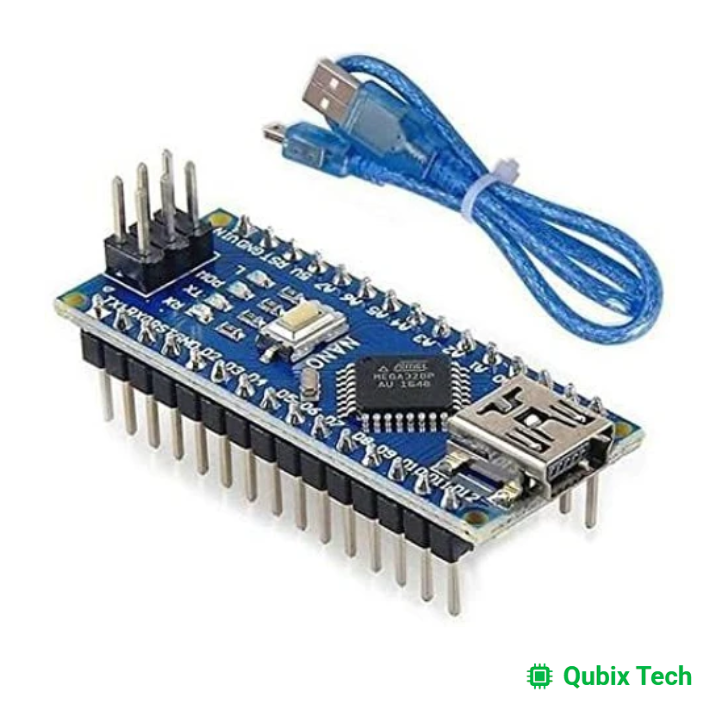
Arduino Nano V3.0 with Cable
The Arduino Nano V3.0 is a compact, breadboard-friendly microcontroller board based on the Atmel ATmega328. Designed for DIY electronics, embedded projects, robotics, and prototyping, it offers the same functionality as the Arduino Uno but in a smaller form factor.

Tianhui TH-T73-05VDC-C-S 5pin T73 Relay

DC 12V Relay OMR ANTEL - 1pcs

0.56 Inch 5161AS 7-Segment LED Digital Display - Red

BC547 NPN Transistor

Resistor 16k ohm 0.25W (1 pcs)

Transparent Green LED Clear 5mm - 10pcs

5v Active Buzzer Long Continous Beep Tone Alarm 12mm Active Piezo Buzzer

4×4 Keypad Keyboard 4×4 Membrane Switches Matrix Keypad 16 Key Thin & Flexible With Cables Connector Keypad 4×4 For Arduino
The 4x4 Membrane Keypad is a compact, lightweight, and easy-to-use input device featuring 16 tactile keys arranged in a 4-row by 4-column matrix. It is ideal for microcontroller projects requiring user input, such as Arduino, Raspberry Pi, ESP8266, and other embedded systems. The thin, flexible design allows for seamless integration into a variety of projects.

Variable Resistor Pot 10K 103

1K (Resistor) Ohm 102 Trimmer Potentiometers Pot Resistors

4 Pin Push Button Switch Small SMD 6x6mm

4 Pin Push Button Switch Small SMD 6x6mm

2 Pin Green Screw Terminal Wire Block Connector

3 Pin Green Screw Terminal Wire Block Connector

HC-05 Bluetooth Module
The HC-05 is a popular, low-cost Bluetooth module for adding wireless serial communication (UART) to microcontrollers like Arduino, supporting Bluetooth 2.0 + EDR, and acting as both a master and slave device, ideal for remote control, robotics, and data transfer, communicating via simple AT commands and a default 9600 baud rate. It's known for its versatility, compatibility with smartphones, and ease of integration, though voltage level shifting (3.3V to 5V) is often needed for Arduino.

9v/12v 2.1mm Female DC Power Jack Socket
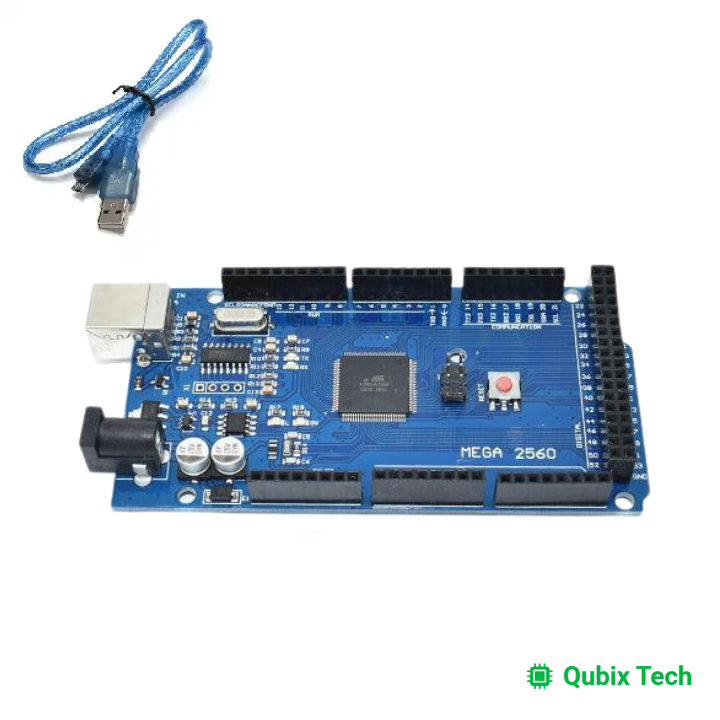
Arduino Mega 2560 R3 (Arduino Compatible) Microcontroller
The Arduino Mega 2560 R3 (Compatible) is a powerful, open-source microcontroller board built around the ATmega2560 chip, designed for complex projects needing extensive I/O, featuring 54 digital pins (14 PWM), 16 analog inputs, 4 UARTs, and 256KB Flash memory, offering seamless compatibility with Arduino IDE and shields, making it ideal for robotics, 3D printing, and advanced IoT applications. "Compatible" versions often use CH340G USB chips but function identically, providing a cost-effective alternative to official boards.

9v/12v DC Power Jack 2.1mm

High Knob 6 Pin 3 Position DPDT Panel Slide Switch 0.5A 50V DC
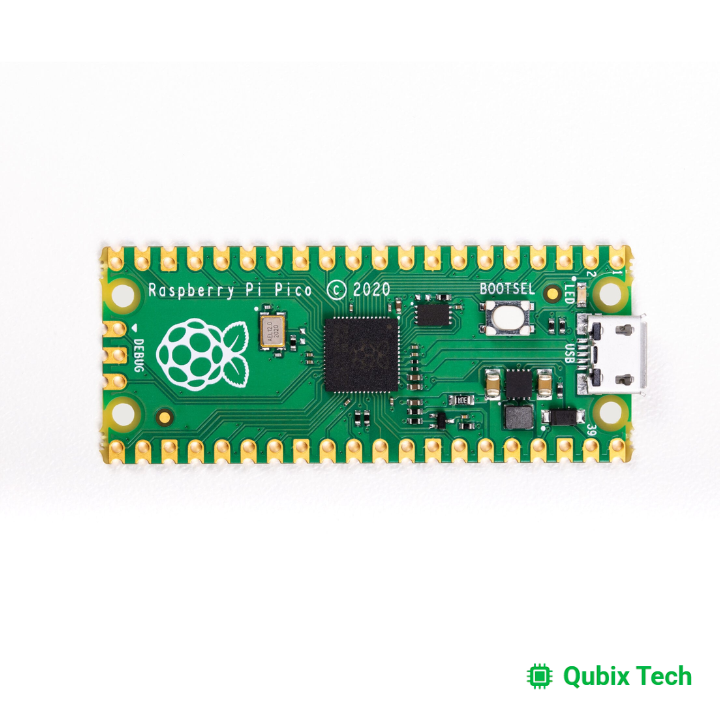
Raspberry Pi Pico microcontroller (Original)
The Raspberry Pi Pico is a low-cost, high-performance microcontroller board designed by Raspberry Pi. It is built around the custom RP2040 microcontroller chip, delivering powerful dual-core processing, flexible input/output options, and low power consumption. The Pico is ideal for embedded systems, IoT projects, robotics, DIY electronics, and educational use. With extensive GPIO capabilities, programmable I/O (PIO), and support for popular programming languages like C/C++ and MicroPython, the Raspberry Pi Pico offers exceptional versatility for both beginners and advanced developers.

6a 250v Ac Spst On-Off Rocker Switch Red

16 PIN IC SOCKET/BASE

22uF 50V Capacitor - 1pcs

NE555/NE555P IC DIP-8 Pin Base for Electronic Projects

LM358 Low Power Dual Operational Amplifier IC - 1pcs

5V Voltage Regulator IC | L7805CV

BD139 100V 1.5A NPN Power Transistor

BD140 PNP Power Transistor

CD4046 IC

Arduino Uno with Cable
Arduino UNO is the best board to get started with electronics and coding. If this is your first experience tinkering with the platform, the UNO is the most robust board you can start playing with. Microcontroller: ATmega328P Operating Voltage: 5V Supply Voltage: 7-12V Maximum supply voltage: 20V Digital I/O Pins: 14 (of which 6 provide PWM output) Analog Input Pins: 6 DC Current per I/O Pin: 40 mA DC Current for 3.3V Pin: 50 mA Flash Memory: 32 KB (ATmega328) of which 0.5 KB used by bootloader SRAM: 2 KB (ATmega328) EEPROM: 1 KB (ATmega328) Clock Speed: 16 MHz

CD4052BE IC (1 pcs)

7402 IC (1 pcs)

7400 IC (1 pcs)

7486 IC (1 pcs)

7404 IC (1 pcs)

7432 IC (1 pcs)

7408 IC ( 1 pcs)

74148 IC (1 pcs)

LM339 IC (1 pcs)

Blue LED - 5 mm - 1 pcs

Red LED - 3 mm (1 pcs)

Green LED - 5 mm (1 PCS)

BC107 NPN Transistor (1 pcs)

2N2222 NPN Transistor (1 pcs)

5mH inductor (1 pcs)

NE555 timer ic


4.7uF Capacitor (1 pcs)

0.1uF Capacitor (1 pcs)

470uF Capacitor (1 pcs)

1F Capacitor (1 pcs)


0.01uF Capacitor (1 pcs)

ESP32-CAM WiFi Module
ESP32-CAM WiFi Module ESP32 Serial to WiFi ESP32 CAM Development Board with OV2640 Camera Module


